The Trial of Dhegdheer Review: A Powerful Community Opera Exploring Truth, Justice and Misinformation in Cardiff
What happens when folklore collides with artificial intelligence, misinformation and a justice system under pressure?
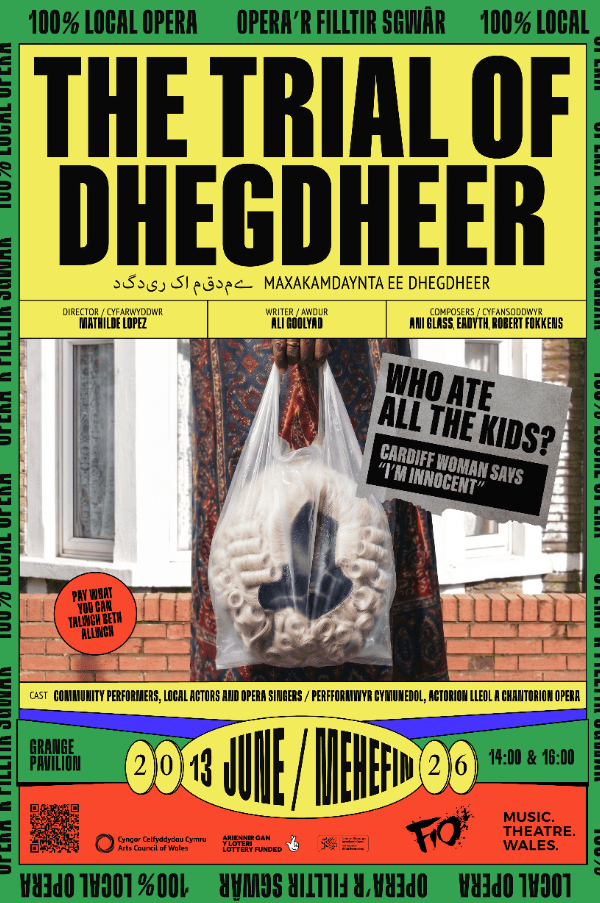
That is the question at the heart of The Trial of Dhegdheer, a bold and thought-provoking new community opera from FIO Theatre and Music Theatre Wales. Created in collaboration with the communities of Grangetown and Butetown, this ambitious production blends Somali folklore, contemporary social issues and lived experience into a unique theatrical event that challenges audiences to consider who gets believed, who gets judged and how easily truth can become distorted.
From the moment I entered the performance space, it was clear that this would not be a traditional opera.
Rather than sitting in rows facing a stage, the audience found themselves inside a courtroom. Actors, performers and audience members occupied the same space, blurring the line between observer and participant. Some audience members were seated amongst the jury, immediately placing us within the action rather than outside it. It was an effective and immersive approach that invited us to become active witnesses to the unfolding trial.
At the centre of the story is a Cardiff woman who believes she has been summoned to court for something as mundane as using the wrong recycling bags. Instead, she finds herself accused of the unthinkable: stealing and eating local children.
As evidence is presented, the audience is introduced to the Somali folktale of Dhegdheer, a legendary figure often portrayed as a child-eating ogress. However, this is no simple retelling of folklore. Fake AI-generated videos and manipulated evidence are brought before the court, raising urgent questions about misinformation, digital trust and how quickly public opinion can be shaped by convincing falsehoods.
The result is a work that feels remarkably timely.
In an era where artificial intelligence is increasingly capable of producing realistic images, videos and voices, The Trial of Dhegdheer explores how technology can influence perceptions of guilt and innocence. The opera asks audiences to consider not only what they believe, but why they believe it.
“Bold, inventive and unapologetically rooted in Cardiff”
Written by Ali Goolyad and directed by Mathilde López, the production handles these complex themes with confidence and imagination. The courtroom proceedings are driven forward at a relentless pace by the Prosecutor, while Ali Star, acting as the defendant's lawyer, attempts to prevent yet another miscarriage of justice before the jury reaches its verdict.
Yet what makes The Trial of Dhegdheer particularly special is not simply its narrative but the way it was created.
Developed through months of collaboration with participants from Grangetown and Butetown, this is genuinely a community-centred work. Local stories, perspectives and experiences have helped shape the production, resulting in a piece that feels deeply rooted in Cardiff and its communities.
There is something powerful about seeing people on stage who may never have considered themselves performers. Community theatre at its best creates opportunities for people to tell their own stories, develop confidence and contribute creatively to something larger than themselves. The Trial of Dhegdheer embraces that ethos wholeheartedly.
The production's musical landscape further reflects this spirit of collaboration. Featuring a Buraanbur singer alongside local performers and community participants, the opera weaves together cultural influences and musical traditions in ways that feel both authentic and innovative. The compositions by Ani Glass, Eadyth and Robert Fokkens help create a sound world that supports the story while celebrating the diversity of voices involved in its creation.
What struck me most throughout the performance was the seamless blending of cultures, traditions and perspectives. Somali folklore sits alongside contemporary Cardiff life. Questions about justice and technology intersect with community experiences and personal histories. The result is storytelling that feels fresh, urgent and unlike anything else currently being produced.
This is not opera in the traditional sense that many people might expect. It is accessible, relevant and deeply connected to the communities from which it emerged. In doing so, it challenges assumptions about who opera is for and what opera can be.
More than a performance, The Trial of Dhegdheer feels like a conversation. It invites audiences to reflect on misinformation, prejudice and collective responsibility while demonstrating the power of community-led arts practice.
At a time when trust in institutions is increasingly questioned and technology continues to reshape how we understand truth, The Trial of Dhegdheer could not feel more relevant.
Bold, inventive and unapologetically rooted in Cardiff, this is community opera at its most ambitious — a powerful example of how local stories can tackle global issues while bringing people together through creativity and shared experience.
It is theatre that doesn't simply ask us to watch. It asks us to participate, to question and ultimately to decide for ourselves.