Art History Essentials: The Cave Paintings That Changed Everything
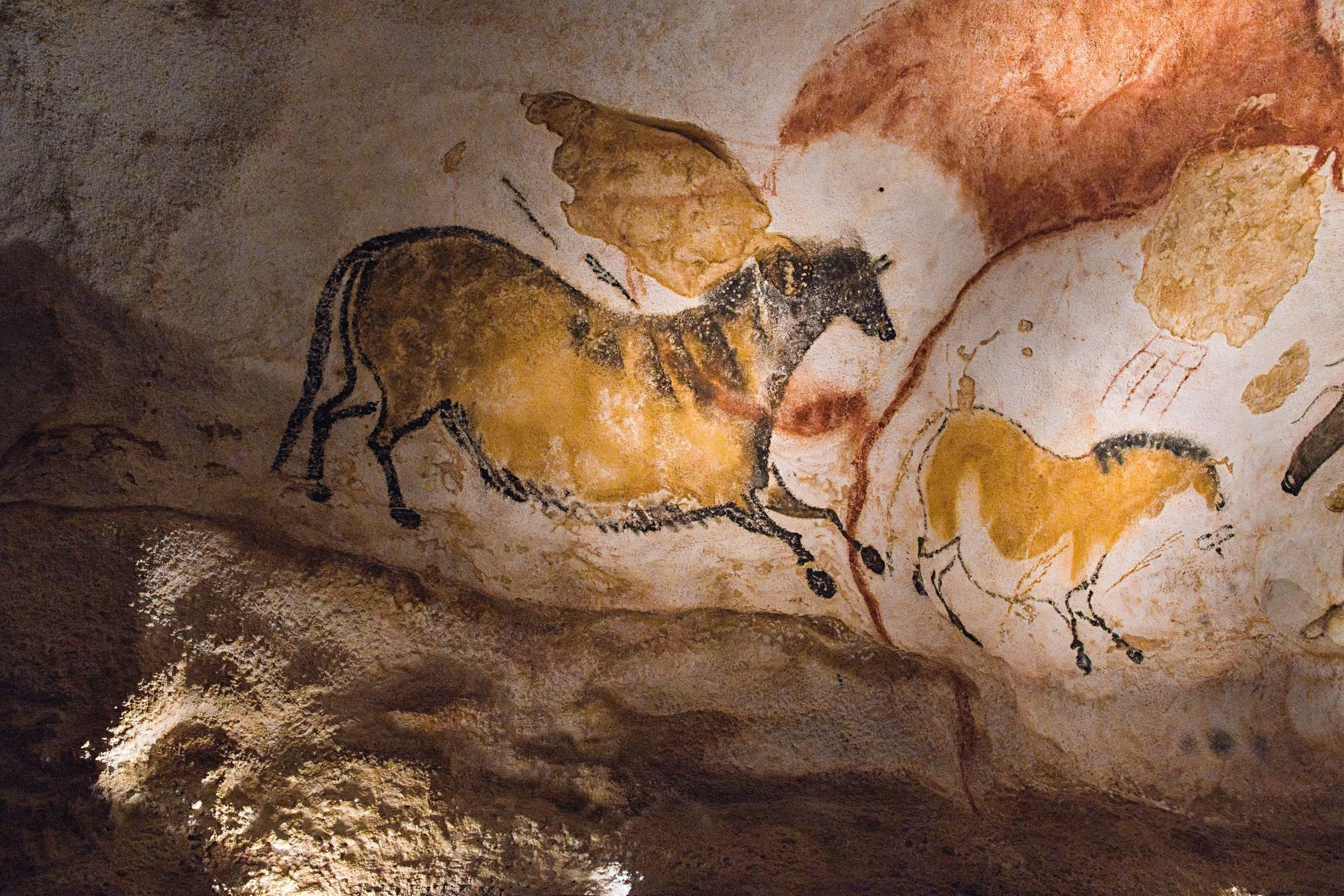
For thousands of years they lay hidden in darkness. Today, the cave paintings of southern France remain some of the most extraordinary works of art ever created—not because they are the oldest, but because they reveal something timeless about what it means to be human.
When we think about the history of art, it is tempting to begin with the Renaissance. Names such as Leonardo da Vinci, Michelangelo and Raphael dominate our understanding of artistic achievement. Yet the true story of art begins tens of thousands of years earlier, long before cities, kingdoms or written language existed.
Deep beneath the countryside of southern France are paintings that fundamentally challenge our assumptions about our prehistoric ancestors. Far from being crude sketches scratched into rock, these images demonstrate remarkable technical skill, careful observation and a sophisticated understanding of movement, composition and storytelling. They are among humanity’s earliest masterpieces.
The Discovery of Lascaux
Perhaps the most famous prehistoric art site in the world is Lascaux Cave, located near the village of Montignac in the Dordogne region of France.
Remarkably, the cave remained hidden until September 1940, when four local teenagers —Marcel Ravidat, Jacques Marsal, Georges Agnel and Simon Coencas— were exploring the woods with Ravidat’s dog, Robot. The dog disappeared into a hole, prompting the boys to investigate. What they found would become one of the most significant archaeological discoveries of the twentieth century.
Beyond the narrow entrance lay an enormous underground gallery covered with paintings of horses, bulls, deer, ibex and bison. More than 600 painted figures and around 1,500 engravings decorate the cave’s walls and ceilings.
The paintings are estimated to be around 17,000 years old, dating from the Upper Palaeolithic period during the Magdalenian culture.
Even today, it is difficult not to be astonished by their quality.
More Than Simple Drawings
Many people imagine cave paintings as primitive stick figures. The reality could hardly be more different.
The animals at Lascaux are painted with confidence and precision. Their muscles ripple beneath their skin. Their legs are positioned to suggest movement. The artists cleverly used the natural bulges and curves of the cave walls to give the illusion of three-dimensional forms.
Some of the bulls in the Hall of the Bulls measure over five metres in length, making them among the largest known prehistoric animal paintings.
The artists also displayed an impressive understanding of colour. They created pigments from naturally occurring minerals, including iron oxide for reds and yellows, manganese dioxide for black and charcoal for deep dark tones. These pigments were mixed with water, animal fat or plant juices before being applied with brushes made from hair, pads of moss, fingers and even hollow bird bones that functioned rather like prehistoric spray guns.
In many ways, these painters were experimenting with artistic techniques that artists continue to use today.
Chauvet: Even Older, Even More Remarkable
Although Lascaux is perhaps the most celebrated prehistoric cave, it is no longer considered the oldest.
That distinction belongs to Chauvet Cave in the Ardèche region of France, discovered in 1994 by three speleologists led by Jean-Marie Chauvet.
The paintings within Chauvet are estimated to be around 36,000 years old, making them more than twice as old as many of the paintings at Lascaux.
What makes Chauvet particularly fascinating is the range of animals depicted. Rather than concentrating primarily on prey species, the artists painted formidable predators including cave lions, woolly rhinoceroses, cave bears and panthers.
The lions are especially striking. Their overlapping bodies create an extraordinary sense of movement, almost resembling frames from an animated film. Some researchers have suggested that the flickering light from stone lamps or torches may have made these layered images appear to move across the cave walls, creating an early form of visual storytelling.
It is a reminder that innovation in art is far older than we often imagine.
Why Were the Paintings Created?
This is perhaps the most fascinating question of all.
Despite decades of archaeological research, no one can say with certainty why these caves were painted.
Several theories have emerged, each supported by varying degrees of evidence.
One long-standing interpretation suggests that the paintings formed part of hunting rituals. By depicting animals in great detail, prehistoric communities may have believed they could influence the success of future hunts through symbolic or spiritual means.
Another theory proposes that the caves functioned as sacred ceremonial spaces. The fact that many paintings are located deep within difficult-to-access chambers suggests these were not ordinary living areas. Reaching some of the galleries requires crawling through narrow passages or navigating steep underground routes, indicating that entering these spaces may itself have held ritual significance.
Other archaeologists argue that the paintings may have served educational purposes, allowing experienced hunters to teach younger members of the community about animal behaviour, anatomy and migration.
More recently, some researchers have suggested they may represent an early form of storytelling. Imagine a group gathered in darkness, illuminated only by flickering lamps fuelled by animal fat. As shadows danced across the cave walls, the painted animals would appear almost alive while stories, myths or lessons were shared.
While we may never know the true purpose of these remarkable works, all of these theories highlight one important point: the paintings almost certainly held deep meaning for the people who created them.
Why Are So Few Human Figures Shown?
One curious feature of European cave art is the overwhelming dominance of animals.
Human figures are surprisingly rare and, when they do appear, they are often simplified or partially animal in form.
No definitive explanation exists, but archaeologists have proposed several possibilities. Animals may have possessed greater spiritual significance, represented clan identities, or simply formed the centre of prehistoric life as essential sources of food, clothing and survival.
Whatever the reason, the emphasis on wildlife reminds us how closely these communities were connected to the natural world.
Protecting a Fragile Masterpiece
Ironically, the greatest threat to Lascaux came not from time, but from popularity.
After the cave opened to the public following the Second World War, thousands of visitors entered every day. The carbon dioxide, heat and moisture produced by human breath began encouraging the growth of algae and fungi, while also damaging the fragile pigments.
By 1963 the situation had become so serious that the French government permanently closed the original cave.
Today, visitors instead explore Lascaux IV, an extraordinarily accurate full-scale reconstruction created using advanced digital scanning and traditional craftsmanship. The replica allows people to experience the astonishing artwork while preserving the irreplaceable originals for future generations.
Similar conservation measures protect Chauvet Cave, where only a handful of researchers are permitted to enter the original site.
Why These Paintings Still Matter
It is easy to view prehistoric people through the lens of technological progress. They had no written language, no metal tools, no cities and no formal education.
Yet they created art capable of moving modern audiences thousands of years later.
These paintings remind us that creativity did not emerge alongside civilisation, it helped shape it.
Long before books, museums or galleries existed, people were already driven by a desire to record their world, communicate ideas and create beauty. Whether these caves served as temples, classrooms, theatres or places of ritual, they demonstrate that artistic expression has always been fundamental to human life.
Standing before a Renaissance masterpiece connects us with an artist who lived five centuries ago. Standing before the paintings of Lascaux or Chauvet connects us with people who lived before farming, before the invention of the wheel and before history itself was written.
That is what makes these caves so extraordinary.
They are not simply the beginning of art history.
They are the beginning of our shared human story.
Art History Essentials is a weekly series exploring the stories, artists and movements that have shaped the history of art. Each article expands on the themes discussed in our weekly podcast Paint in the Arts, taking a deeper look at the fascinating people, places and ideas behind some of the world’s greatest works of art.