This summer, artist Sara Hartel takes to the skies — literally — as their new aerial‑circus theatre work Foreigner in My Body tours to five venues across Wales. Blending movement, theatre, and aerial silks with integrated audio description and captions, the show is a bold, surreal exploration of identity, autonomy, and the strange dislocation of feeling foreign both in a country and in one’s own skin.
Born in Germany and now based in Wales, Hartel has built a reputation for interdisciplinary work that refuses to sit neatly in a single genre. Their previous projects — from the riot‑inciting Strike Ltd. to the gaming‑infused GORE — have consistently pushed at the edges of form and audience expectation. Foreigner in My Body continues that trajectory, but with a new level of intimacy and vulnerability.
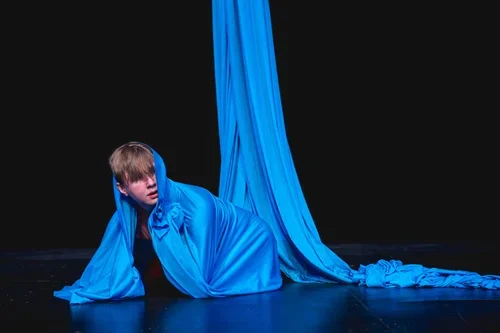
At its centre is Sandra, a character guided — and sometimes controlled — by a pre‑recorded audio description voice that insists on describing them in hyper‑feminine terms. As Sandra navigates a surreal landscape of airport security, luggage carousels, and bureaucratic absurdity, the show interrogates who gets to define a body, who gets to narrate a life, and what happens when those narratives clash.
Despite its themes — trans identity, migration, bodily autonomy, and the dehumanising machinery of borders — the work is playful, humorous, and defiantly joyful. Hartel describes it as “an autobiographical lie”: rooted in lived experience, but shaped through metaphor, movement, and theatrical exaggeration rather than literal retelling.
With support from Arts Council Wales, the show tours to Barry, Cardigan, Llanelli, Pontypridd and Milford Haven, bringing accessible, experimental performance to audiences aged 13+.
What follows is an edited conversation with Sara, discussing the show’s development, the role of circus in storytelling, and the emotional labour of turning personal experience into performance.
INTERVIEW WITH SARA HARTEL
(Edited for clarity and length. Listen in Full at the bottom of this Article)
For readers new to your work, what is Foreigner in My Body?
It’s a show that merges theatre and circus in a way I hope is interesting and unexpected. One of the key elements is that we use audio description as part of the storytelling. There’s a pre‑recorded audio describer who describes me — a non‑binary trans person — in very feminine terms. It forces me to perform a kind of femininity that’s often associated with aerial silks. Eventually I have to break free from that and establish my own voice.
The show explores my transness, but also my experience as a foreigner in the UK. It’s about belonging, identity, and feeling like a foreigner inside your own body.
How long has this idea been developing?
Years. It started as a completely different concept — an interactive theatre piece where audiences would uncover truths about characters. That didn’t get picked up, but later I received accessibility training focused on movement. Because I was already training in circus, I combined the two and realised you can reveal or obscure truth through audio description.
I kept circling around ideas of gender and how people describe gender. Then, during a residency at The Place in Newport, it clicked that it wasn’t just gender — it was also about being a foreigner. Those two experiences were shaping how I felt about my body and how others took ownership of it.
You’ve spoken about difficult experiences with the UK immigration system. Did that feed into the work?
Yes, emotionally. At one point my daughter and I were detained by border forces because of a dispute about her citizenship. That feeling of being dehumanised definitely influenced the show. But I don’t tell that story literally — I didn’t want to create trauma porn or put my actual experiences on stage in a way that felt unhealthy.
Instead, I draw from the emotions. The show is an “autobiographical lie”: it’s rooted in truth, but the narrative is fictional.
Circus is a big part of the piece. Why was aerial silks the right medium for this story?
Silks are beautiful and elegant, but they’re also coded as very feminine. Even though it takes a huge amount of strength, the aesthetic is all softness and flow. That movement quality isn’t quite me, so I became interested in finding my own movement language within it.
Circus also lets me express things that words can’t. There’s a section where Sandra is discovering themselves while I’m tangled in the silks, and the audio description talks about being caught in paperwork and finally breaking free. The movement and the metaphor work together.
The show integrates audio description and captions. How did that shape the creative process?
It shaped everything. We even did clowning exercises with an audio describer who would describe increasingly ridiculous things for me to do in the moment. That unlocked a lot of the humour in the show. It sounds like a dark piece — being trans, being a foreigner — but it’s actually very playful and tongue‑in‑cheek.
You’re touring the show across Wales. How challenging is it to tour circus work?
Very! It’s been hard to find theatres that can rig for aerial silks. But we’ve managed to build a tour: Barry Memo, Small World in Cardigan, Ffwrnes in Llanelli, Citrus Arts in Pontypridd, and the Torch Theatre in Milford Haven. I’m really excited to share it with audiences.
What do you hope people take away from Foreigner in My Body?
Joy. Even though the themes are serious, the show is centred in joy. And I hope people think about who gets to describe us, who gets to define us, and how we reclaim our own narratives.
Listen to the Full Conversation Here:
TOUR DATES
12 June — Barry Memo
19 June — Small World Theatre, Cardigan
4 July — Ffwrnes, Llanelli
24 July — Citrus Arts, Pontypridd
29 July — Torch Theatre, Milford Haven
Follow Sara on Instagram: @sara.hartel.7
Foreigner in My Body is supported by Arts Council Wales.