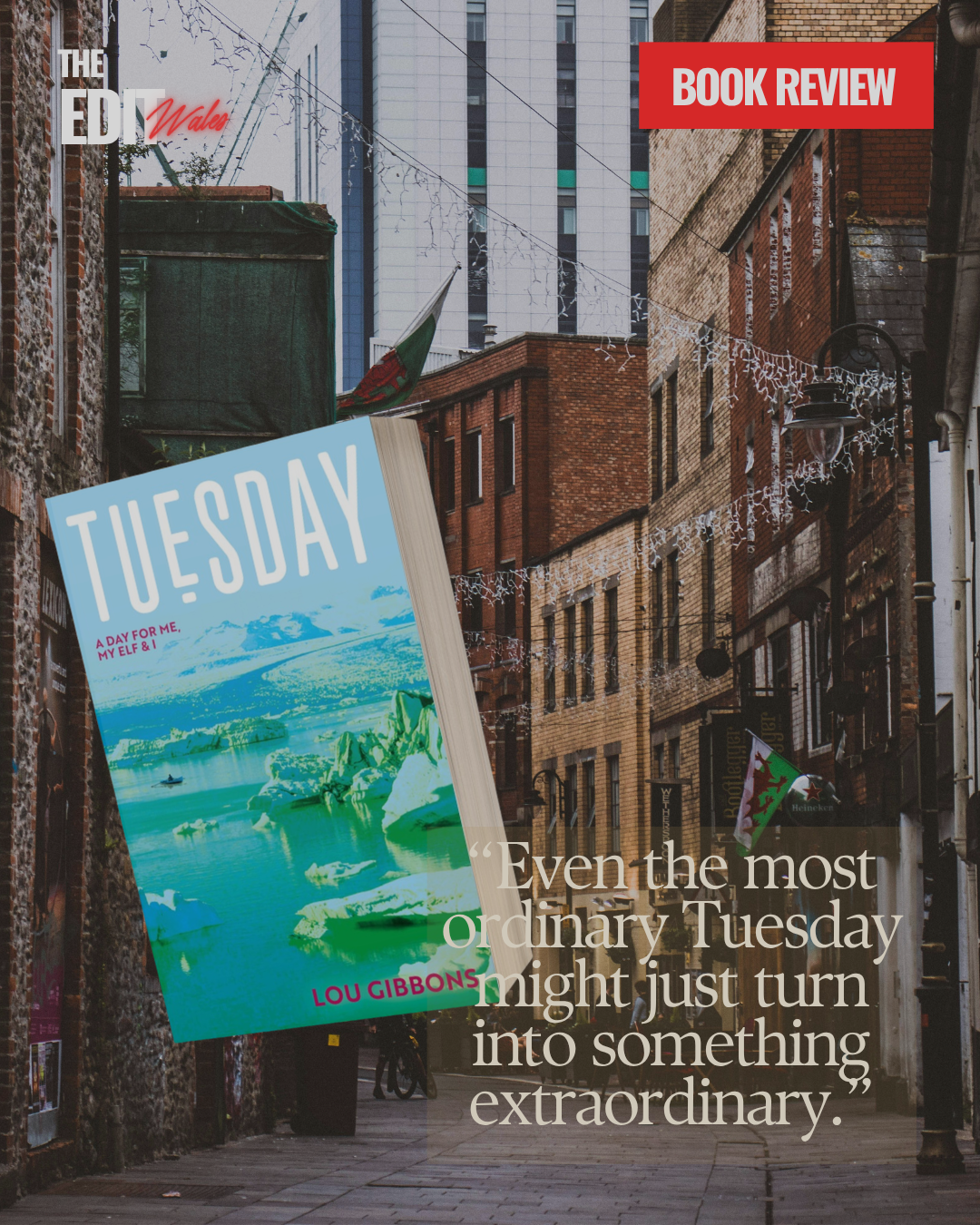
Book: Tuesday
Author: Lou Gibbons
Genre: Contemporary fiction, comedy, magical realism
What happens when an ordinary Tuesday turns into something quite extraordinary? For Dave Welch, things are already looking rather bleak. At 49, the former Welsh rugby player finds himself stuck in a job that has lost its purpose, a marriage that is struggling and a relationship with his teenage son that could certainly do with some attention. His career at the Cardiff Investment Agency is going nowhere, his confidence is at an all-time low and his professional reputation is hanging by a thread.
With just three weeks to secure a major investment project and save his position, Dave is presented with what looks like the perfect opportunity. Great Brakes, an ambitious green technology company, promises jobs and investment for Wales. But as Dave becomes increasingly caught up in the project, he finds himself questioning just how green the company’s intentions really are.
Then comes Sal, a mysterious stranger in a red hat, whose arrival takes Dave on a rather unexpected journey. What follows is an increasingly surreal adventure involving folklore, Icelandic landscapes, environmental intrigue and some very unusual encounters.
Lou Gibbons, who was born in Manchester and grew up in Wales, brings a wonderfully playful imagination to Tuesday. Much of the story is rooted in Cardiff, with Welsh politics, the Senedd, rugby culture and the familiar frustrations of public sector working life providing a recognisable backdrop. There is plenty here for Welsh readers to enjoy, particularly Gibbons’ observations about the peculiarities of political life and the pursuit of investment in Wales.
One of the things I particularly enjoyed is the central character himself. Dave is far from your conventional literary hero. He is occasionally selfish, rather too comfortable taking the easy route and seemingly incapable of recognising his own shortcomings. Yet there is something wonderfully human about him. Gibbons doesn’t try to make him perfect or even particularly likeable all of the time. Instead, she gives us a character whose flaws make his journey all the more entertaining.
His internal monologue is frequently hilarious, and the dialogue has a lovely natural rhythm. There is a distinctly British sense of humour running through the book, with plenty of dry observations, awkward encounters and moments of laugh-out-loud absurdity. The supporting cast adds to the fun, particularly the mysterious Sal and the wonderfully direct Jolene.
Beneath the comedy, however, there is a more serious story taking shape. Environmental responsibility is one of the novel’s central themes, with Great Brakes raising questions about corporate greenwashing, political ambition and the consequences of putting economic growth ahead of the natural world.
One passage that particularly stood out to me was:
“The planet is an ecosystem built on many equally delicate ecosystems. Different but all connected.”
It is a simple but effective observation that captures one of the book’s underlying messages. Our actions have consequences, and the decisions made in the pursuit of progress can have a much wider impact than we might initially realise.
The Icelandic elements bring another fascinating dimension to the story. Gibbons contrasts the familiar surroundings of Cardiff with dramatic landscapes, folklore and a sense of mystery that gives the novel its more fantastical edge. The interplay between the ordinary and the extraordinary is one of the book’s greatest strengths, keeping the reader guessing about what is real, what is imagined and what might be possible.
There are also some lovely reflections on personal responsibility and the possibility of change. Dave has spent much of his life blaming circumstances and other people for where he has ended up. Through his increasingly bizarre experiences, he is forced to reconsider his choices and the person he has become.
As Sal’s world begins to influence his own, there is a particularly memorable observation:
“Your thoughts are actions, Dave. They sow the seeds of what you become.”
It is a sentiment that sits at the heart of the novel. Tuesday is ultimately as much about rediscovering yourself as it is about the strange adventures that take you there.
The book is an easy and engaging read, with 41 relatively short chapters and a lively pace that makes it difficult to put down. Gibbons balances the more thoughtful moments with humour and an imaginative storyline, never allowing the environmental themes to overwhelm the entertainment.
What I particularly appreciated was the book’s willingness to embrace the unusual. It is not afraid to be a little eccentric, and that is precisely where much of its charm lies. There are moments that feel almost dreamlike, unexpected turns that take the story somewhere entirely different and a central character whose journey is both amusing and surprisingly touching.
There is a line towards the end of the novel that I think captures its spirit rather beautifully:
“Madness is merely an exaggeration of the truth.”
And perhaps that is the point. Sometimes we need to step outside the familiar, question what we believe and allow ourselves to see the world differently.
Tuesday is a wonderfully entertaining and imaginative novel that combines Welsh settings, sharp British humour and a surprisingly thoughtful message about the world we live in. Lou Gibbons has created something a little different, with enough eccentricity to keep things interesting and plenty of heart beneath the madness.
A refreshing read that reminds us that even the most ordinary Tuesday might just turn into something extraordinary.