“A Triumph of the Human Spirit”: Bill Ward on Shawshank, Creativity and the Pull of the Coast
Actor and photographer Bill Ward is preparing to return to the Wales Millennium Centre with The Shawshank Redemption. Before we get to the brutality, hope and humanity of the production, our conversation begins somewhere far gentler: the South Wales coastline. It turns out Bill knows it intimately — camera in hand, boots on the sand, and an eye for the drama of the sea.
What follows is a lightly edited transcript of our conversation.
Jack Merriman Photography
Chris Birch:
Before we get into Shawshank, I feel like we need to start with something you mentioned earlier — your love of Southerndown, Rest Bay, and that stretch of coastline. Tell me more about that connection.
Bill Ward:
I’m not just an actor — I’m a photographer, a landscape photographer in fact, and I’ve always been drawn to the sea. You’ve got some of the most glorious coastline in the country. I live in Bristol, so your beaches are the nearest proper white‑sand beaches to me. Bristol Channel is beautiful in its own muddy way, but it’s not quite the same.
Southerndown, Porthcawl, Rest Bay, Ogmore… they’re absolutely stunning. And Nash Point — the geology there is extraordinary. I spend a lot of time with a camera along that whole stretch. You’re very lucky to live where you do.
“I’m not just an actor — I’m a photographer, and the sea has always pulled me in.”
Chris:
You’re clearly creative on multiple fronts — acting, photography, teaching. How do you find the time?
Bill:
I tend to say I do both acting and photography full‑time, which means there aren’t many hours left in the day once you add in my partner and two children. But I like being busy.
I often run the two side by side. I take my camera to every acting job. I photograph whatever I bump into — observational work in cities, more considered work in the landscape. When I’m in Cardiff next week, the camera’s coming with me.
Chris:
Speaking of Cardiff — you’re heading to the Bay because you’ve moved from The Full Monty into The Shawshank Redemption. That’s quite a tonal shift.
Bill:
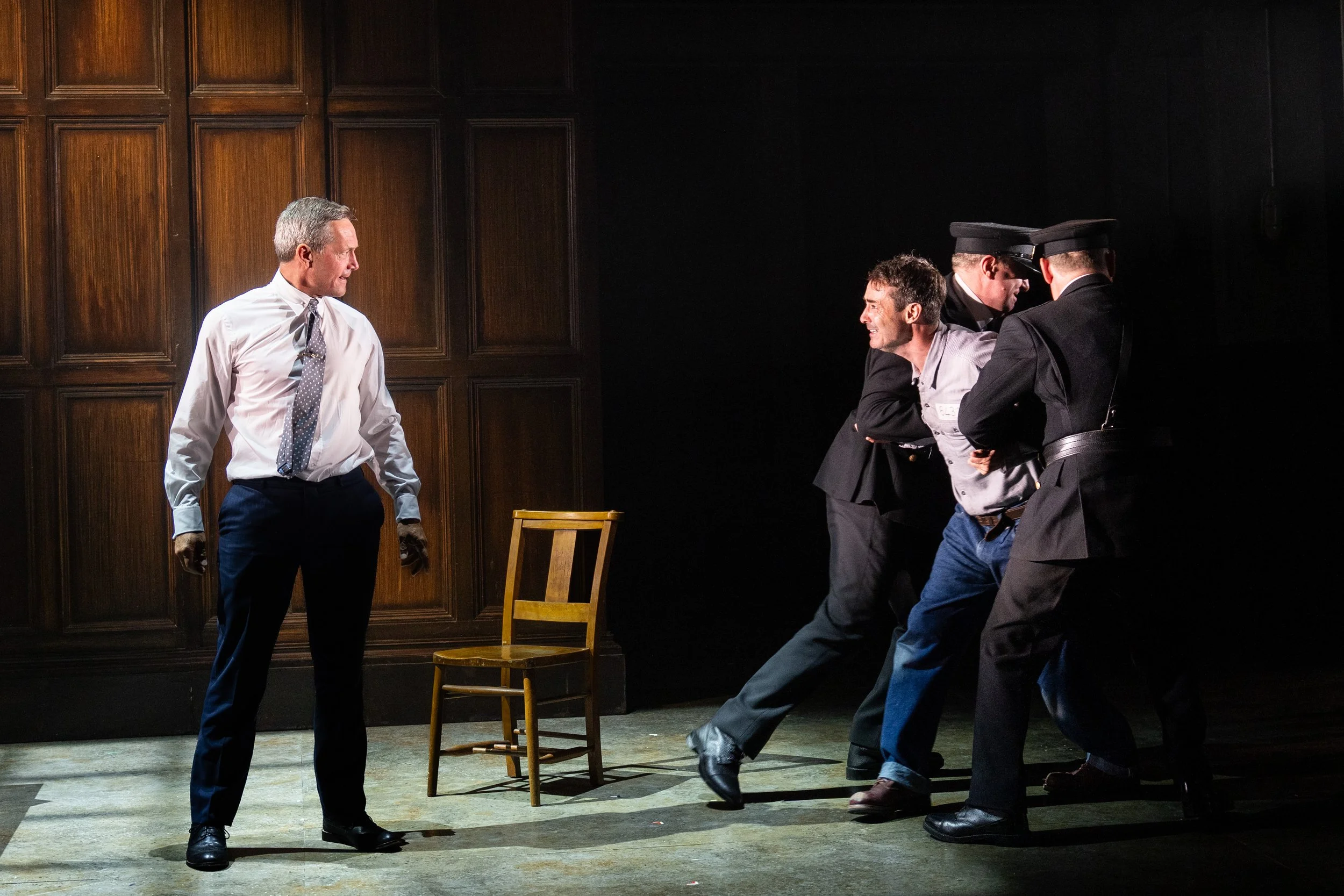
You could say that. It’s a massive shift, but a delightful one. In The Full Monty I played Gerald — the quiet, slightly ineffectual foreman with a gnome fixation. Now I’m playing Warden Stammas, a ruthless, God‑fearing Baptist in Shawshank.
What’s interesting is that both shows are uplifting, just in very different ways. The Full Monty has this glitzy reputation because of the final dance, but underneath it’s a story about what men do when everything is taken from them. It’s about the male psyche, the human spirit.
And Shawshank shares that thread. At its heart, it’s about friendship — male love, really — between Andy Dufresne and Red Redding. Two men in a dark, violent place who look after each other. So even though the shows look wildly different, there’s a connection.
Chris:
Your character, Warden Stammas, isn’t exactly known for his humanitarian streak.
“Theatre is about asking: what would I do in that circumstance?”
Jack Merriman Photography
Bill:
No, he’s not winning any awards for kindness. But what’s fascinating is that he thinks he’s entirely reasonable. He believes he’s acting in the best interests of the state, rehabilitating offenders, and doing whatever is necessary to maintain order.
He’ll allow certain contraband until it crosses a line, and then he comes down like a ton of bricks. He’s a conflation of three characters from Stephen King’s original novella — the wheeler‑dealer, the brutal enforcer, and the devout Baptist. So he’s complex. He can quote the New Testament word for word, yet he’s capable of extreme ruthlessness.
When you play someone like that, you can’t judge them. You have to work backwards from the words to the thoughts — what does he believe that allows him to behave like this? He thinks he’s doing everyone a favour.
Chris:
I’ve seen photos of the set — stark, imposing, atmospheric. How does that environment shape your performance?
Bill:
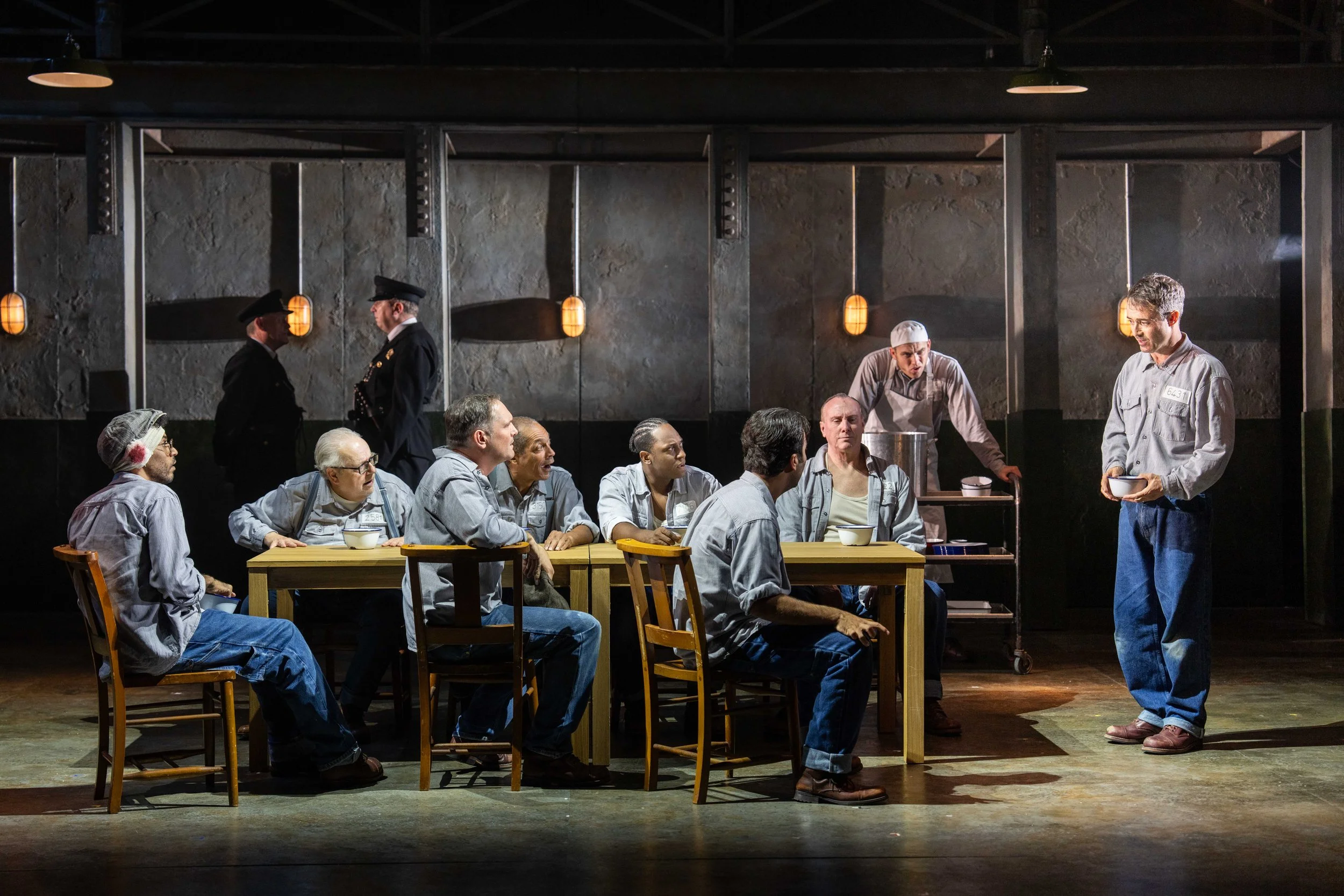
It’s incredibly oppressive, in the best possible way. The set is designed almost like a metal quadrant, so sound reverberates around it. Scenes are often played in tiny pools of light, within the confines of a cell. The colour palette is bleached and bleak — no bright colours anywhere.
The lighting, sound and set design all work together to create this sense of constant threat. Violence is always present. And because the world is so stripped back, the moments of hope at the end feel astonishingly powerful. You suddenly realise you haven’t seen colour for two and a half hours.
Chris:
Is there a particular moment in the show you look forward to each night?
Bill:
The final few minutes are very beautiful and hugely uplifting. My character isn’t on stage at that point, so I get to watch from the wings and feel the mood lift in the building. It’s joyous.
Chris:
What do you hope audiences walk away thinking or feeling?
Bill:
That they’ve been taken on a journey. Theatre is about holding up a mirror to us as humans — asking what we’re like, what we’d do in impossible circumstances.
Andy Dufresne is wrongfully imprisoned, and the journey he goes on to win his freedom is brutal. You can’t help but ask yourself: Would I have done that? Could I? Would I have the courage to keep fighting?
The themes are universal: hope over adversity, staying true to yourself, the power of friendship. Even though the material is dark, audiences come out uplifted. They feel what’s possible for a human being, even in the bleakest conditions.
Chris:
We also run the Pain in the Arts Podcast, and we get questions submitted regularly. One of them feels perfect for you: How do you deal with burnout when creativity is your job?
Bill:
Variety. That’s the key.
Acting is all giving out — you’re transferring energy to an audience. At some point, you have to put something back in. Photography does that for me. When I’m out at Southerndown or Nash Point, I’m reconnecting with nature. That’s my regeneration time.
I photograph alone unless I’m teaching. It’s me meeting Mother Nature on her own terms. That’s the yin to acting’s yang.
I once did a personality test with my family and discovered I’m almost exactly 50% extrovert, 50% introvert. I’m not someone who can go from acting job to acting job without a break. I need reflective time. In a group of actors, I’m often the quietest one.
So avoiding burnout is about balance — giving out and putting back in.
Chris:
You’re back on stage Tuesday night at the Wales Millennium Centre. Are you excited?
Bill:
Very. We haven’t done the play for eleven weeks — we had a Christmas break, and I was doing panto in Redditch, which was huge fun. So we’re all really looking forward to getting back to it.
As we wrap up, Bill promises we’ll probably bump into each other on the South Wales coast at some point — camera in hand, no doubt. And after hearing him speak about Shawshank, creativity, and the quiet power of nature, it’s easy to imagine him there: watching the tide, waiting for the light, and finding the balance that keeps the work alive.