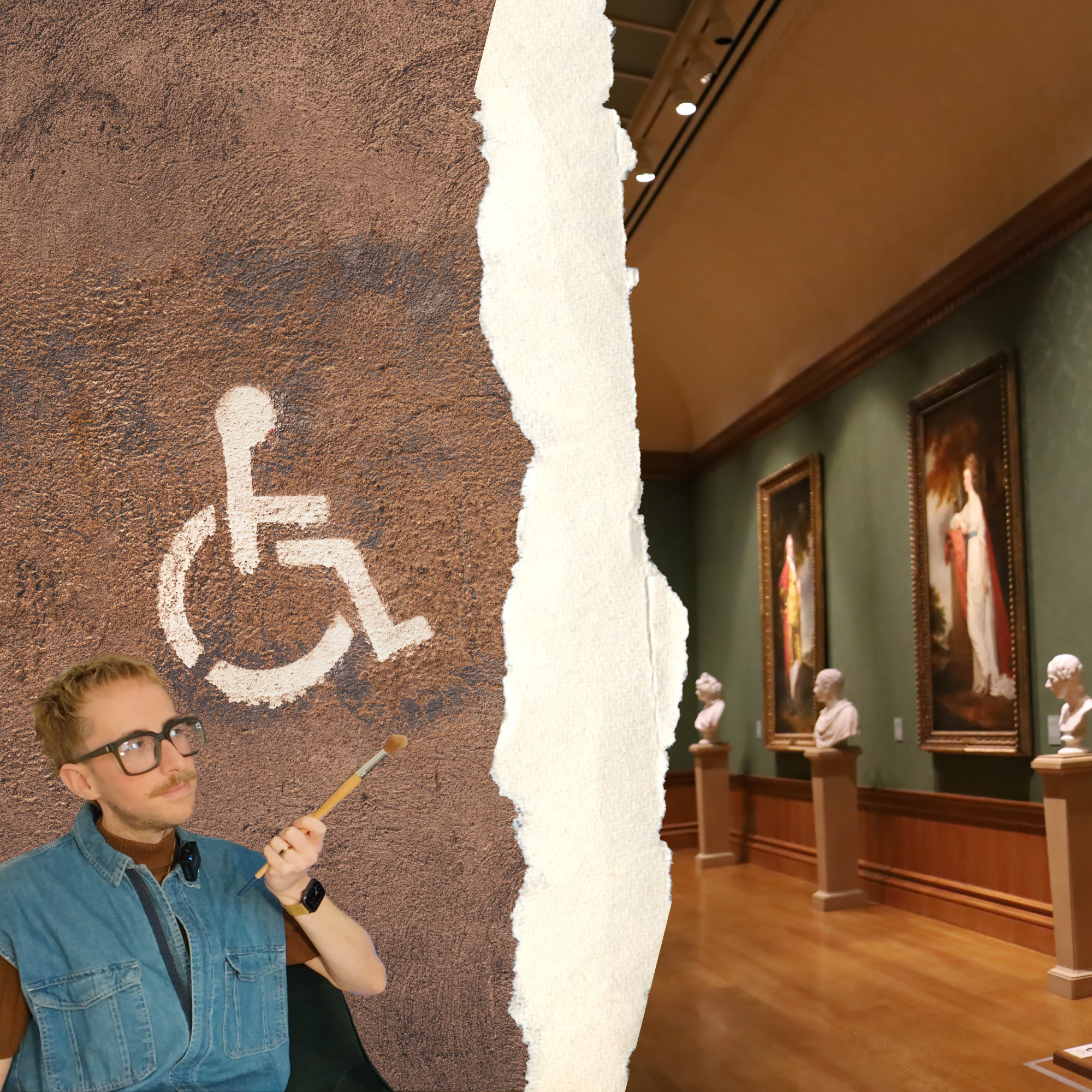
Each week on Pain in the Arts, the podcast I co-host, we open the floor to questions from listeners. Sometimes they’re practical, sometimes philosophical, sometimes they are down right hilarious and spark comedic conversation to see the light at the end of the creative chaos tunnel, however, occasionally they force you to look at the arts ecosystem in a completely different way.
This week’s question did exactly that: what adjustments do you see – or wish you could see more of – to include the disability community within the audiences of art performances?
At first glance it feels like a straightforward access question. Ramps, captions, relaxed performances, audio description. The sort of checklist many venues already claim to have addressed.
But as I started speaking to people – from parents of neurodivergent children to disability-led arts practitioners – the conversation quickly shifted. Access, it turns out, is rarely about a single adjustment. It’s about the entire experience.
Starting with the uncomfortable question
One of the most striking provocations came via Stephanie Bailey-Scott from Taking Flight Theatre Company. She recalled hearing a talk by performer and activist Jess Thom that completely reframed the conversation for her.
Instead of asking how to include disabled audiences, Thom reportedly asked a director: “Who do you not want to see your show?”
It’s a deceptively simple question. Work backwards from that answer, she suggested, and the barriers become visible.
Because barriers are everywhere once you start looking for them.
The basics still matter
Many of the adjustments people mentioned are, by now, familiar: wheelchair-accessible seating, step-free entry, captioning, audio description, British Sign Language interpretation, relaxed performances, and clear pre-show information.
Yet the fact these features are still being repeatedly requested suggests something important: they are far from universal.
Parents I spoke to who attend theatre with neurodivergent children talked about the anxiety of simply not knowing what to expect. One described spending hours combing through websites to find out whether their child might cope with a performance. Would there be loud bangs? Flashing lights? Opportunities to move around if needed?
Sometimes the information exists – buried three pages deep in a PDF. Sometimes it doesn’t exist at all.
The irony is that pre-show information is one of the most powerful and inexpensive accessibility tools available. Visual guides, sensory information, content warnings and clear descriptions can transform an unknown experience into something manageable.
Without them, the risk simply feels too high.
Access as a one-off gesture
Another theme emerged repeatedly: accessibility being treated as a special event rather than a standard offer.
A theatre might programme one captioned performance during a two-week run, or one relaxed performance tucked away on a weekday afternoon.
Technically, access has been provided. In reality, it often means disabled audiences must reshape their lives around a single available slot.
As Bailey-Scott pointed out, adjustments mean little if they exist only once. Access needs to be visible, frequent and normalised.
Not an exception. A default.
The attitude problem
Perhaps the most revealing conversations weren’t about physical access at all.
They were about attitude.
You can have every adjustment imaginable on paper, but if the welcome at the door feels reluctant or confused, the message is clear: this space wasn’t really designed with you in mind.
By contrast, when venues actively celebrate their accessibility – when access information is easy to find, when staff are confident and informed, when materials are proudly displayed rather than quietly available on request – the atmosphere changes.
It signals that disabled audiences are not an afterthought.
They are acknowledged, expected and welcomed.
The visibility of access
One thing Bailey-Scott highlighted stayed with me: seeing access materials clearly and proudly displayed.
It’s a small detail with a big psychological effect. A pile of sensory guides at the box office. A sign explaining available adjustments. A member of staff offering assistance without hesitation.
These gestures make accessibility visible. And visibility matters, because it tells audiences that someone has already thought about their needs.
In other words, it removes the exhausting labour of having to ask.
Listening to the community
Perhaps the most consistent advice I heard was also the simplest: listen.
Disabled audiences already know what works. Disability-led organisations, artists and advocates across Wales have spent years developing creative solutions. Companies like Taking Flight Theatre Company have built entire practices around access as an artistic principle, not just a logistical one.
The challenge is that mainstream institutions sometimes approach access as something to retrofit rather than something to design collaboratively from the start.
That approach inevitably leaves gaps.
What happens when access becomes the starting point?
The more people I spoke to while researching this question, the more I found myself circling back to another one: why aren’t we making work in the arts more regularly for disabled communities in the first place?
So much of the conversation around access focuses on adjustments – the idea that a “standard” cultural experience exists, and then modifications are made so disabled audiences can join it. But what happens when that assumption is flipped?
I was reminded of this when I went to review Martha at the Sherman Theatre. The production was created with deaf and hard of hearing audiences in mind. Rather than captions being an optional add-on, subtitles were incorporated directly into the staging as part of the visual language of the show.
As a hearing audience member, that accessibility was suddenly being offered to me.
Nothing about the experience felt diminished. If anything, the opposite was true. The captions became another storytelling device – another layer of design and meaning. It was a reminder that access tools aren’t purely functional; they can also be creative.
The same idea exists elsewhere in the arts, though not nearly often enough. Tactile exhibitions that invite audiences to touch and hold artworks challenge the traditional gallery rule of “look but don’t touch”. Theatre made by and for neurodivergent audiences can reshape expectations around silence, stillness and audience behaviour. Work led by visually impaired artists often prioritises sound, texture and spatial awareness in ways that change how everyone experiences a space.
In these moments, the perspective flips.
Instead of disabled audiences being invited into an existing framework, the framework itself is built from disabled experiences outward. And suddenly it’s the non-disabled audience who are being asked to adapt.
What strikes me is how generative that shift can be. These works don’t feel like compromised versions of something else. They feel inventive, expansive – often more imaginative than the so-called “standard” model they disrupt.
Which raises an uncomfortable but necessary thought: perhaps access becomes difficult when we treat disabled audiences as an afterthought. When they are at the centre of the creative process, entirely new artistic possibilities open up.
The questions that remain
Even after these conversations, I’m left with questions.
Why are some access measures still treated as luxuries rather than essentials?
Why do disabled audiences still have to search so hard for basic information?
And what might the arts look like if access wasn’t an add-on, but a starting point?
The answers, I suspect, lie less in infrastructure and more in imagination.
Because accessibility, at its heart, is about who we believe the arts are for.
And who we expect to see sitting beside us in the audience.
to listen to the full podcast episode where Jak & Chris answer this question are more click here!