HOP – The Hopeful Hare: A Story of Grief, Healing and Hope Takes Flight in Swansea
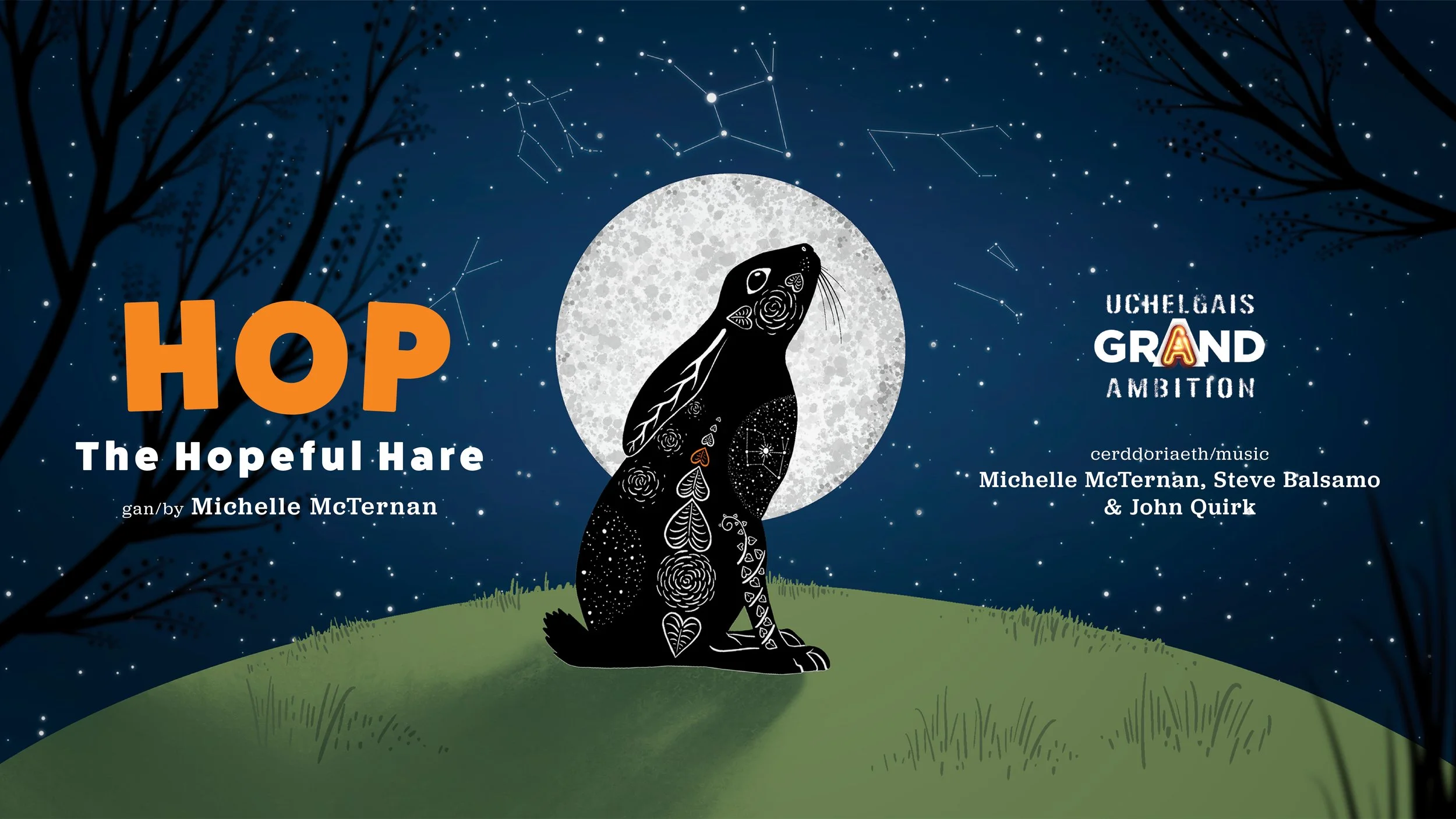
Grand Ambition’s newest production, HOP – The Hopeful Hare, arrives at Swansea Grand Theatre this March, bringing with it a tender, imaginative exploration of grief, change and the small glimmers of hope that help us through difficult times. Written and directed by Michelle McTernan, with original music by McTernan, Steve Balsamo and John Quirk, the show blends puppetry, animation and song to create a gentle, nurturing space for young audiences and their families.
The story follows Grandpa, who tends his garden each spring — until his crops begin disappearing overnight. Determined to catch the culprit, he discovers not a fox or a bird, but Hop: a tiny hare with a huge heart and an even bigger appetite. Through Hop’s mischief, Grandpa is guided back towards hope after loss.
Ahead of the production’s opening, I sat down with Michelle and Steve to talk about the origins of the story, the emotional landscape behind it, and the responsibility of creating theatre that speaks honestly to children.
In Conversation with Michelle McTernan and Steve Balsamo
Edited for Clarity
Chris: Michelle, let me start with you. What sparked the idea for HOP – The Hopeful Hare, and why does now feel like the right moment to tell this story?
Michelle: It actually began with a puppet — a friend bought me a little hare peeking out of a cabbage leaf. At the time I was running Jamba Drama, telling stories to children with puppets, and I wondered what tale I could tell with this one. On a drive from Cardiff to Swansea, the whole story came to me in verse. I was in that flow state where you’re scrambling for your voice recorder because you don’t want to lose a line.
I told that story for years, and eventually realised it could become a theatre piece. When we founded Grand Ambition, we talked about the audiences we wanted to reach — especially children and families. I read the story to the team, and they immediately felt there was something special in it. That’s when I began adapting it for the stage and imagining songs.
Chris: Which brings us neatly to Steve. The music is original and collaborative — how did you and John Quirk approach building the world of HOP?
Steve: Being part of Grand Ambition is wonderful because ideas are always floating around. Michelle mentioned HOP one day in the office, and I just picked up a guitar and said, “Tell me the words.” We started shaping melodies right there.
I’ve always loved children’s storytelling — Bagpuss, Mr Benn, Sesame Street, the Muppets. In another life I’d probably be a puppeteer. So this felt very natural. Michelle is a brilliant songwriter and lyricist, and we’d record ideas on our phones, then build them up.
Bringing in John Quirk was the final piece. He’s an extraordinary musician with a deep knowledge of musical theatre. He took our ideas and wove them into something incredibly emotional. I still get moved thinking about it.
Chris: The show is aimed at young audiences, but it deals with grief and change. How did you find the balance between honesty and gentleness?
Michelle: With a lot of care. I worked closely with dramaturg Sarah Argent — she’s one of the best in children’s theatre — and with grief counsellor Glenys Benford Lewis. They helped ensure we were hitting the right emotional notes.
The key is bravery. We have to allow ourselves to go into the depths of grief, but we guide audiences back through music, animation and the relationship between Grandpa and Hop. Children understand far more than we often give them credit for. If we build characters they love, they’ll go on that journey with us.
Chris: Wales is often stereotyped as stoic — the stiff upper lip, keep‑calm‑and‑carry‑on mentality. It feels bold to create a children’s show that addresses grief so openly.
Michelle: Grief is awkward because it’s so individual. Nobody knows the “right” way to navigate it. At Grand Ambition, our work often centres on difficult conversations — taking them from the street to the stage. We always think about how our audiences will feel, especially when many children will be stepping into a theatre for the first time.
Chris: Michelle, who is Hop to you?
Michelle: Hop is hope. In a world that feels overwhelming — with wars, hardship, uncertainty — hope can be found in the smallest things: a rainbow, a smile, a kind gesture. In our story, maybe it’s a hare from the constellation Lepus. Hop arrives when you need him and leaves when you don’t — a bit like Mary Poppins of the garden.
Steve: For me, hares are deeply rooted in folklore — magical, transformative, trickster figures. Hop feels spiritual, almost archetypal. And because I’m navigating my own grief after losing my dad and another father figure, the story resonates deeply. It’s transformational.
Chris: Did those emotions shape the music?
Steve: Completely. Music is medicine. We wanted the songs to act as glimmers — little moments of light. And we never underestimate children. We aimed to write the best songs we could, not “children’s songs”, just great songs. Paul Williams, who wrote Rainbow Connection, is a big inspiration.
Chris: Michelle, you’ve spoken before about losing your son Harry. How did your personal experience shape the story?
Michelle: Harry died in 2011, when he was five. Grief is an unwanted guest that never leaves, but I choose to live well — for myself, my husband, and our son Dylan. When I first wrote HOP, grief wasn’t part of it. But as I developed the story, it naturally wove itself in.
My mum passed away last year, and my dad now lives with us. So Grandpa’s grief for his wife reflects what I see at home. Harry is in the story, my mum is in it, my dad, Dylan — they’re all there. The garden becomes a metaphor for memory and growth. Writing it has been vulnerable and brave, but also healing.
Chris: What do you hope families talk about after seeing the show?
Michelle: I want them to ask questions. To have conversations they might otherwise avoid. We’ve created resource packs for families and teachers — activities, constellation drawings, letters to Grandpa — to help continue those discussions. And we have a wellbeing team available for audiences as well as the cast. Ultimately, I want people to enjoy the show, feel safe, and feel held.
Steve: It’s a story about healing on many levels. If families leave feeling connected — to each other, to their emotions, to hope — then we’ve done our job.
Listen in Full (Unedited) Here
HOP – The Hopeful Hare runs 4–13 March at the Swansea Grand Theatre, Arts Wing, with school performances at 10.30am on weekdays. The production features original music, puppetry, animation, integrated BSL and closed captions, and is suitable for ages 4 and above.
Created by Grand Ambition, the show is produced in partnership with Harry’s Fund and Joseph’s Smile, and funded by Swansea City Council and the Arts Council of Wales.