Blue | Glas: A visceral journey through grief, connection and new beginnings
There are some performances that ask you to sit back and enjoy them. Others make you feel as though you have been invited somewhere you perhaps shouldn’t be.
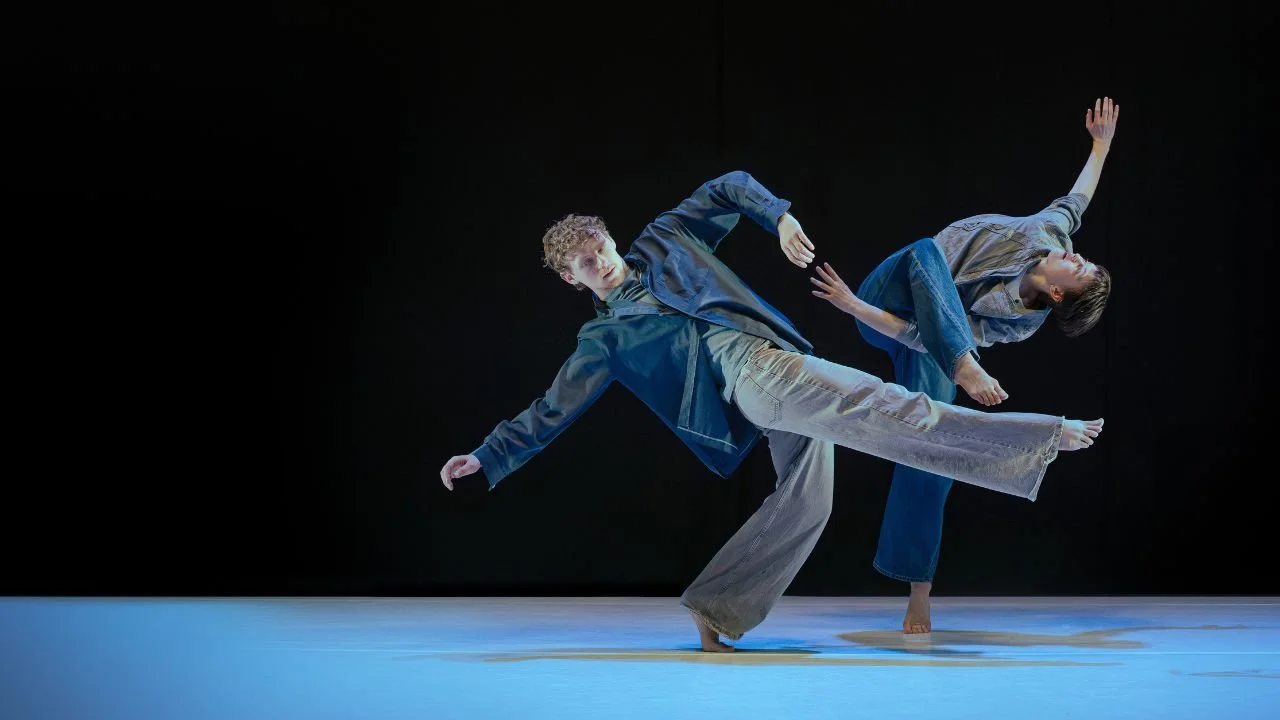
National Dance Company Wales’ Blue | Glas falls somewhere between the two.
Bringing together Theo Clinkard’s Ordinary Courage, originally created in 2012, with Alesandra Seutin’s brand-new Untamed, the double bill takes audiences through two very different explorations of what it means to lose, to survive and ultimately to keep moving.
I went into the performance knowing that Ordinary Courage explores grief and the loss of Clinkard’s mother, but knowing what a piece is about and experiencing it are very different things.
The uncomfortable intimacy of grief
There were moments during Ordinary Courage when I felt genuinely uncomfortable watching.
Not because the work was difficult to understand, but because it felt so personal. There was a strange sensation of feeling like a tourist onlooker, watching something that felt too intimate to be witnessing. At times, I found myself almost feeling as though I should look away.
That discomfort is part of what makes the piece so affecting.
Grief is not presented as a neat journey from sadness towards recovery. Instead, the dancers inhabit the unevenness of it. There is loss, vulnerability and isolation, but also the moments of joy and connection that remind us why human contact matters so much when we are at our most fragile.
Those moments of connection felt particularly powerful. There is something deeply recognisable in the desire to reach out to another person, to be held, understood or simply not be alone. Ordinary Courage manages to find something universal within an experience that is, ultimately, deeply personal.
The simplicity of the staging allows those human moments to remain at the centre. Rather than overwhelming the audience with spectacle, the work gives the dancers room to communicate through their bodies, with Alan Stones’ haunting score providing an emotional undercurrent.
It is a piece that stays with you, partly because it makes you question your own position as an audience member. Are you witnessing somebody else’s grief, or are you recognising something of your own within it?
Perhaps it is both.
Running towards something new
If Ordinary Courage asks us to sit with loss, Untamed feels like the moment when something inside you starts to move again.
Alesandra Seutin’s new work is visceral, complex and deliberately feels as though it is building towards something bigger.
There is a constant sense of potential. Each movement feels like the beginning of something else, gradually gathering momentum before bursting into larger, more expansive sequences. The physicality of running is always present, but Seutin uses it for something much more interesting than simply representing movement from one place to another.
Are we running away from something, or are we running towards something new?
That question seems to sit at the heart of Untamed.
The dancers' bodies become charged with that tension. There is struggle, exhaustion, instinct and release, with the choreography gradually transforming that physical effort into something that feels almost primal.
By the end, Untamed feels like a rebirth. A shedding of what has been holding you back and the possibility of beginning again.
The music and lighting are particularly effective in creating that feeling. Rather than simply accompanying the movement, they seem to operate on an instinctual level, adding to the sense that what we are watching is something deeply human. The score, created by Randolph Matthews with Welsh harpist and vocalist Sam Frankie Fox, brings together traditional Welsh instruments, local voices and Welsh learners, with the sound of the pibgorn adding another distinctive layer to the piece.
Alys Davies draws the eye
It is difficult to single out one dancer from such a strong company.
There were moments when my attention moved around the stage, trying to take in everything that was happening, and the ensemble worked incredibly well together.
But whenever Alys Davies was on stage, my eyes seemed to find her.
It didn't matter whether she was front and centre or making small, inward movements towards the back of the stage. There was a quality to her movement that felt incredibly human, a kind of natural grace that worked beautifully across both pieces.
That is perhaps one of the most impressive things about NDCWales' dancers. Even when the choreography is demanding and the stage is full of movement, individual performers can still create a connection with the audience.
A surprisingly varied audience
One of the things I always find myself doing at a production is looking around the room.
Who has come to see this? Who is the work speaking to? Does the audience reflect the people I expected to be here?
Blue | Glas surprised me.
The audience felt like a genuine mix of people, rather than a room filled exclusively with established contemporary dance audiences. I was sitting near what appeared to be two groups of younger dancers, and for much of the performance they seemed completely absorbed.
Watching them leave afterwards, there was a real sense of enthusiasm for what they had just seen.
That felt particularly significant.
Contemporary dance can sometimes feel intimidating from the outside, but Blue | Glas demonstrates how accessible the form can be when it is rooted in something as recognisable as grief, human connection, fear, instinct and the desire to start again.
For those younger dancers in the audience, I couldn't help wondering whether this might be one of those performances that stays with them. Perhaps it will influence something they create years from now. Perhaps it will simply remind them why they fell in love with dance in the first place.
Either way, there seemed to be a renewed enthusiasm for the craft as people made their way out of the theatre.
Two journeys, one human experience
Ordinary Courage and Untamed are very different pieces, but together they create a surprisingly coherent evening.
One asks us to look directly at grief and the complicated ways we find our way through it. The other asks what happens when we stop allowing ourselves to be contained and begin moving towards something new.
For me, Untamed ultimately had the stronger impact. There was something about its sense of charged bodies, instinct and transformation that felt incredibly powerful. Its gradual build towards release made the final movement feel like a genuine new beginning.
But it is the contrast between the two works that makes Blue | Glas so compelling.
One looks backwards at what we have lost. The other looks forwards at what we might become.
And somewhere between the two is that very human instinct to keep moving.
Blue | Glas is touring across Wales and England throughout September, October and November 2026, with performances at venues including Sherman Theatre in Cardiff, Sadler’s Wells East in London, Theatr Clwyd in Mold, Pontio in Bangor and Aberystwyth Arts Centre.
Performance dates and times vary by venue, so for full tour dates, performance times and ticket information, visit NDCWales.